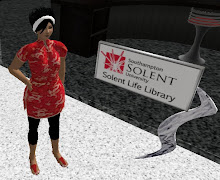
You know those silly internet personality quizzes...? I can blame someone from the Uni up the road for alerting me to this one.
"You scored as Blue. You are considered to be a very calm person who takes things one at a time and does not worry too much about the consequences. Whatever happens, happens, is your moto. You are the one people come to for advise on most topics, because you are filled with limitless knowledge. You can handle any situation."
Yes, that and the fact that I spend a fair bit of my time behind a desk over which hangs a sign saying 'Enquiries'!
[Example of limitless knowledge: I know that a 'moto' is an Italian motor scooter. I think they mean motto.]
Monday, October 09, 2006

Wednesday, October 04, 2006
Poll Builder
Today I found that those clever people at The Center for History and New Media have a very nifty Poll Builder which lets you... you guessed? Build polls. It literally takes a minute to do. That is, it took me a minute to do once I'd switched to Firefox, it didn't seem to want to play in Explorer (I haven't tried it in any other browsers as yet.)
Thursday, September 28, 2006
Writely
Another collaboration tool I've recently signed up for is Writely, which lets you share word processed documents. You can import a document from Word or create it in Writely and invite whoever you want to view and/or edit it. It beats sending files back and forward as attachments via email.
As you may have guessed from recent posts I'm experimenting with ways of writing a paper with someone in another location - a university 'down the road a piece' from here.
As you may have guessed from recent posts I'm experimenting with ways of writing a paper with someone in another location - a university 'down the road a piece' from here.
Monday, September 25, 2006
Seething with life
Suddenly there are alot of people about. What was, until last week, a quiet, almost deserted campus is suddenly seething with life.
I get an odd idea, at this time of year, that someone might actually read this blog. I'm not sure that a librarian's blog is all that appealing in terms of reading matter but sometimes, when you know you really should be reading the set text, almost anything is more appealing, so you never know. Anyway, if you are a new student and you're reading this - hello and welcome!
I get an odd idea, at this time of year, that someone might actually read this blog. I'm not sure that a librarian's blog is all that appealing in terms of reading matter but sometimes, when you know you really should be reading the set text, almost anything is more appealing, so you never know. Anyway, if you are a new student and you're reading this - hello and welcome!
Thursday, September 14, 2006
Conference : The International Learner: Enhancing the student experience.
I was lucky enough to spend the last two days out of the office at a conference put on by the Business School. We were looking at the international student experience. This left me mulling over the usefulness of generalisations. It can be useful, in terms of providing services, to know that students from other parts of the world may be more likely to have problems with this or that or the other thing, but generalisations are positively unhelpful if we start trying to apply them to individuals. No one likes to be treated as a 'type' rather than as a person.
Something else it left me mulling over is that no one else in the world seems to like English food.
Something else it left me mulling over is that no one else in the world seems to like English food.
Wednesday, August 30, 2006
A bit of a panic
I got back from my holidays and had a bit of a panic over the number of things I'd not yet done to prepare for the new academic year. There are the routine things like updating leaflets, checking that we have books people have requested etc, and I think I'm on top of those now. Just about. But there are other things that are more work but are also more fun, like trying to keep up to date with new developments in the wider information world. The wider information world is a seething mass of new developments, of course, Google alone would be enough to keep tabs on, which makes it quite a challenge.
Friday, August 04, 2006
A librarian by any other name...
At various times in the librarianship world the issue is raised of whether to call ourselves something different. It's all to do with the thorny issue of the 'public image' of librarians which, to be quite honest, is not good.
I hadn't come across the word 'infornography' until recently. Perhaps we could start calling ourselves infornographers?
I hadn't come across the word 'infornography' until recently. Perhaps we could start calling ourselves infornographers?
Wednesday, August 02, 2006
Reading about Library 2.0
I try, when I can, to fit some professional reading into my working day. (I'm a librarian for goodness sake why should I, of all people, feel guilty about being seen reading - as if it isn't 'real work'!?)
Something I've noticed lately is that I'm finding more of interest in online and open access journals than I am in the print journals we subscribe to, and occasionally I come across an article that is even worth blogging about, like this one from Webology on that complex mix of things that is often referred to as 'Library 2.0'.
It suggests that one of the greatest challenges for libraries, (and I'd imagine it's the same for all organisations) is that of giving up control over the virtual environment and being open to involvement from, and participation by, the whole community.
What would happen if we let students add tags to our catalogue records, chat online, contribute to wiki's, take part in podcasts? Would it be anarchy and chaos? Or might it be fun?
Something I've noticed lately is that I'm finding more of interest in online and open access journals than I am in the print journals we subscribe to, and occasionally I come across an article that is even worth blogging about, like this one from Webology on that complex mix of things that is often referred to as 'Library 2.0'.
It suggests that one of the greatest challenges for libraries, (and I'd imagine it's the same for all organisations) is that of giving up control over the virtual environment and being open to involvement from, and participation by, the whole community.
What would happen if we let students add tags to our catalogue records, chat online, contribute to wiki's, take part in podcasts? Would it be anarchy and chaos? Or might it be fun?
Tuesday, August 01, 2006
Bookshops, budgets and Basingstoke.
Sometimes, as a special treat, we get let loose in a bookshop with a budget to spend. That's what I was doing yesterday, in Blackwells in Oxford. Actually being able to pick up and handle real books as a way of selecting stock is good once in a while, although using bibliographic databases and reviews is probably a more sensible way to do it most of the time.
Luckily, for the sake of my personal budget, my time was fully occupied in the Business section and I didn't have time to get distracted by areas of more personal interest!
On the way home I got an unexpected evening excursion to Reading and Basingstoke. Whenever I travel by rail, wherever I am going, I always seem to end up in Basingstoke.
Luckily, for the sake of my personal budget, my time was fully occupied in the Business section and I didn't have time to get distracted by areas of more personal interest!
On the way home I got an unexpected evening excursion to Reading and Basingstoke. Whenever I travel by rail, wherever I am going, I always seem to end up in Basingstoke.
Tuesday, July 25, 2006
Looking forward to induction week
We had a meeting of local business librarians today to talk about our plans for induction. At this time of year induction week starts to loom large on the horizon, so it was a good opportunity to compare notes and share ideas. It was also an excellent excuse to spend a morning in our wonderfully air-conditioned meeting room.
Somehow I managed to drag blogs and RSS feeds into it towards the end. So hello to anyone who may be reading this blog as a result!
Somehow I managed to drag blogs and RSS feeds into it towards the end. So hello to anyone who may be reading this blog as a result!
Tuesday, July 18, 2006
biz/ed podcasts
While I'm on the subject of podcasts I ought to mention biz/ed's excellent weekly series on business issues currently In the News. The latest one (at the time of writing this) looks at whether Airbus or Boeing have made better strategic decisions about the way their market is going.
HBR Podcasts
I see Harvard Business Online are now offering a free bi-weekly podcast called IdeaCast.
My favourite was Episode Four's segment on how to make really great mistakes. I hope this blog is the kind of mistake they're talking about!
My favourite was Episode Four's segment on how to make really great mistakes. I hope this blog is the kind of mistake they're talking about!
Monday, July 17, 2006
Courses: Planning and Designing Technology-rich Learning Spaces
The most inspiring part of this one day JISC course was the tour of the University of Warwick’s Learning Grid. Not just for the flexible layout, although that was an excellent example of it's kind, with tables and chairs, whiteboards and screens that could be positioned to suit whoever was using the space. Not just for the technology-rich environment, with desktop pc’s, space and power for laptops, smartboards, plasma screens and bookable presentation rooms.
For me the highlight was all this plus a deliberate move away from the traditional rules beginning with ‘NO…’! That gave it a very different atmosphere to the usual library or IT resource centre, and it must be even more so in term time.
Most student support is provided by student helpers, rather than librarians or IT staff, so it's largely run by and for students. The emphasis is very firmly on being positive and finding solutions. For example, if the Grid is getting close to full capacity then staff might suggest using the nearby café – also within the wireless network area - or might help negotiate moving furniture around to create a better use of space.
Talking of café’s, cold food and hot and cold drinks are allowed. It seems that many students go to the traditional library (which is still available, and hasn't been replaced by the Learning Grid) to borrow books, then bring the books plus drinks and sandwiches to the Grid and settle in for the whole day. As well as food, talking is allowed. Mobile phones are allowed. Moving the furniture is allowed. Accessing audio and video content via internet is allowed, with or without headphones. Hot food is just about the only thing not allowed, not for worries about it being dropped on the books or equipment, but simply because of the smell that tends to linger. Basically pretty much anything is allowed that helps people to get on with their work the way they want to.
I know it wouldn't be everyone's idea of what a library should be, but I liked it, and it seems like a lot of students do too.
You can take an online tour to see what it's like.
The most uninspiring part of the day? The technology-rich, laptop friendly Virgin train breaking down in Basingstoke on the way home, leaving us going nowhere, in a train with no air-con and doors that wouldn't open (thankfully only briefly) on one of the hottest days of the year!
For me the highlight was all this plus a deliberate move away from the traditional rules beginning with ‘NO…’! That gave it a very different atmosphere to the usual library or IT resource centre, and it must be even more so in term time.
Most student support is provided by student helpers, rather than librarians or IT staff, so it's largely run by and for students. The emphasis is very firmly on being positive and finding solutions. For example, if the Grid is getting close to full capacity then staff might suggest using the nearby café – also within the wireless network area - or might help negotiate moving furniture around to create a better use of space.
Talking of café’s, cold food and hot and cold drinks are allowed. It seems that many students go to the traditional library (which is still available, and hasn't been replaced by the Learning Grid) to borrow books, then bring the books plus drinks and sandwiches to the Grid and settle in for the whole day. As well as food, talking is allowed. Mobile phones are allowed. Moving the furniture is allowed. Accessing audio and video content via internet is allowed, with or without headphones. Hot food is just about the only thing not allowed, not for worries about it being dropped on the books or equipment, but simply because of the smell that tends to linger. Basically pretty much anything is allowed that helps people to get on with their work the way they want to.
I know it wouldn't be everyone's idea of what a library should be, but I liked it, and it seems like a lot of students do too.
You can take an online tour to see what it's like.
The most uninspiring part of the day? The technology-rich, laptop friendly Virgin train breaking down in Basingstoke on the way home, leaving us going nowhere, in a train with no air-con and doors that wouldn't open (thankfully only briefly) on one of the hottest days of the year!
Tuesday, July 11, 2006
Podcasting
I suppose it's because CW and I are doing quite similar jobs, in academic libraries on opposite sides of the planet, but it's remarkable how often she blogs about something that I'm trying to get to grips with. We'd decided that July was going to be the month we investigated the possibilities of podcasts, and look what today's entry is! I really ought to comment more often but it might be a bit embarrassing to keep popping up saying, "ooh yes, me too!"
Thursday, July 06, 2006
Elit 2006 - light bulb
I thought I'd highlight a few of the 'light bulb moments' from Elit 2006 but then I realised that there was really only one key theme that cropped up in several different sessions.
eliteracy is obviously a key concern of librarians but it is not something that librarians alone can address. It does not fall neatly into any one group's remit. It crosses the boundaries of library, IT, learning technologists, study skills tutors, and lecturers. We all have a tendency to concentrate on and so sometimes to over-estimate the importance of the bit of the process that we know best. We need to get over this and learn to work together in a much more joined up fashion, keeping an appropriate balance between IT skills, information retrieval skills, research skills, thinking skills, skills in analysis, argument and presentation. Someone needs to take a strategic overview and connect up the pieces. This really has to be led by academic staff. When I can do a library training session that fits into a structured course that is looking at all aspects of eliteracy, I find it works much better than if I do a session that is just library training in isolation from the rest of the learning process.
eliteracy is obviously a key concern of librarians but it is not something that librarians alone can address. It does not fall neatly into any one group's remit. It crosses the boundaries of library, IT, learning technologists, study skills tutors, and lecturers. We all have a tendency to concentrate on and so sometimes to over-estimate the importance of the bit of the process that we know best. We need to get over this and learn to work together in a much more joined up fashion, keeping an appropriate balance between IT skills, information retrieval skills, research skills, thinking skills, skills in analysis, argument and presentation. Someone needs to take a strategic overview and connect up the pieces. This really has to be led by academic staff. When I can do a library training session that fits into a structured course that is looking at all aspects of eliteracy, I find it works much better than if I do a session that is just library training in isolation from the rest of the learning process.
Monday, July 03, 2006
work/life life/work
I wasn't sure where to put this blog entry. It's about writing so maybe it should go on my writing group blog, but it's about work, so perhaps it should go on my work blog. Sometimes life is not so neatly compartmentalised!
I've found that creative writing and ordinary, everyday writing are more closely related than you might think. Since I've been doing writing exercises (fiction and non-fiction) I've found it easier to write anything. I'm not so daunted by word counts. I have an idea how much I can convey in 500 or 1000 words and what kind of structures work. I've some experience of how to write differently when the words are to be spoken aloud, which helped in writing the same paper for delivery at a conference and for subsequent submission for publication.
Having to read out my writing group exercises - something I hated doing at first - has helped to get me used to the idea of public speaking to a wider audience.
I'm pretty sure that blogging contributes to this as well. It's a form of regular writing exercise that helps me focus on how to express thoughts and record events in a reasonably concise format.
I've found that creative writing and ordinary, everyday writing are more closely related than you might think. Since I've been doing writing exercises (fiction and non-fiction) I've found it easier to write anything. I'm not so daunted by word counts. I have an idea how much I can convey in 500 or 1000 words and what kind of structures work. I've some experience of how to write differently when the words are to be spoken aloud, which helped in writing the same paper for delivery at a conference and for subsequent submission for publication.
Having to read out my writing group exercises - something I hated doing at first - has helped to get me used to the idea of public speaking to a wider audience.
I'm pretty sure that blogging contributes to this as well. It's a form of regular writing exercise that helps me focus on how to express thoughts and record events in a reasonably concise format.
Saturday, July 01, 2006
eLit 2006 - black hat
I got back from the eLit 2006 conference yesterday and am trying to get some thoughts down in writing as soon as possible. I know that if I go back to my scribbled notes in a week's time I'll end up frowning at them, wondering what on earth I meant. After two or three weeks, if I haven't followed up an idea and done something about it then, realistically, I probably won't ever get around to it. After a conference or training session it's easy enough to be enthusiastic and full of ideas, but doing something about it is another thing.
I want to sort out which of all the many ideas that were discussed would be the most practical to take forward. I know that some, if not most, would involve collaboration with others who have the necessary skills to enable things to actually happen and won't be practical without that. I know that my time is limited and if I try to do too much I'll risk failing to complete anything. I think I ought to set myself a deadline of one month to prioritise things I want to take forward and actually do something about them.
Having blogged that thought, of course it's now date stamped and I can't easily wriggle out of it!
I want to sort out which of all the many ideas that were discussed would be the most practical to take forward. I know that some, if not most, would involve collaboration with others who have the necessary skills to enable things to actually happen and won't be practical without that. I know that my time is limited and if I try to do too much I'll risk failing to complete anything. I think I ought to set myself a deadline of one month to prioritise things I want to take forward and actually do something about them.
Having blogged that thought, of course it's now date stamped and I can't easily wriggle out of it!
eLit 2006 - yellow hat
eLit 2006 was a very positive experience. It's encouraging to know that I'm part of a profession that can put on events like this where there are not just librarians present but a mix of different people who all have an interest in e-literacy issues. It's good that we can look beyond the boundaries of our traditional roles and think about new ways of working for everyones benefit.
The experience of presenting a paper has helped me extend the boundaries of my comfort zone. I can't say "I couldn't do that" any more, because now I've done it!
There were a huge number of ideas generated by the various sessions, as well as by conversations over breakfast, lunch and dinner. It would be good to make use of some of these ideas. I need to set aside some time at work in the next couple of weeks to go through my notes and extract the best ideas, and to share them with colleagues.
The experience of presenting a paper has helped me extend the boundaries of my comfort zone. I can't say "I couldn't do that" any more, because now I've done it!
There were a huge number of ideas generated by the various sessions, as well as by conversations over breakfast, lunch and dinner. It would be good to make use of some of these ideas. I need to set aside some time at work in the next couple of weeks to go through my notes and extract the best ideas, and to share them with colleagues.
eLit 2006 - green hat
At times during eLit 2006 you could have imagined you were at a creative thinking conference. I suppose the theme of digital literacy tends to attract those who are interested in doing innovative things with all the new technologies that are now available, but people were also finding new ways to use old tools and technologies. Presentations included using mind mapping software to convey complex information previously held in inch thick instruction manuals; using blogs and wikis for collaborative work; providing students with furniture on wheels to organise their own learning spaces; using online discussion lists to encourage cross-gender academic debate in remote areas of the Middle East; using web-based survey tools to gather research data, and using a variety of social networking software in all kinds of ways.
At one point a small light bulb lit up for me when a lecturer expressed the hope that librarians would help the academic staff they work with to keep up with the potential uses of all the new developments that are going on, and how they might be relevant for research and for teaching. I think I could be doing a lot more in this area.
Perhaps we could produce a series of podcasts or a wiki covering how various new tools and technologies could contribute to teaching and learning and research? We know that information like this is more useful if it can be provided at the right time, when it's most relevant to people, rather than en-block in a training session. Podcasting or wiki would suit the rapid pace of change and might be a good way to enable people to access what they want, when they want it.
This is all green hat, blue sky type thinking of course, so I don't have to worry about who 'we' might be or any other practicalities at the moment!
At one point a small light bulb lit up for me when a lecturer expressed the hope that librarians would help the academic staff they work with to keep up with the potential uses of all the new developments that are going on, and how they might be relevant for research and for teaching. I think I could be doing a lot more in this area.
Perhaps we could produce a series of podcasts or a wiki covering how various new tools and technologies could contribute to teaching and learning and research? We know that information like this is more useful if it can be provided at the right time, when it's most relevant to people, rather than en-block in a training session. Podcasting or wiki would suit the rapid pace of change and might be a good way to enable people to access what they want, when they want it.
This is all green hat, blue sky type thinking of course, so I don't have to worry about who 'we' might be or any other practicalities at the moment!
Subscribe to:
Posts (Atom)